Download the guide
You can download the guide in Word and PDF formats now.
Download the editable word version preparing for emergencies
Download the printable PDF version preparing for emergencies
Download the screen reader friendly version preparing for emergencies
Alternate accessible formats and editable PDFs will be available in 2026, led by the National Emergency Management Agency. You can find more information about emergencies on their website: Get Ready Alternate formats
Interactive preparedness workshops will also be rolling out across the Wellington region in 2026, with support from Whaikaha – Ministry of Disabled People. These sessions will build on the guide and help people put their planning into action.
About the Guide
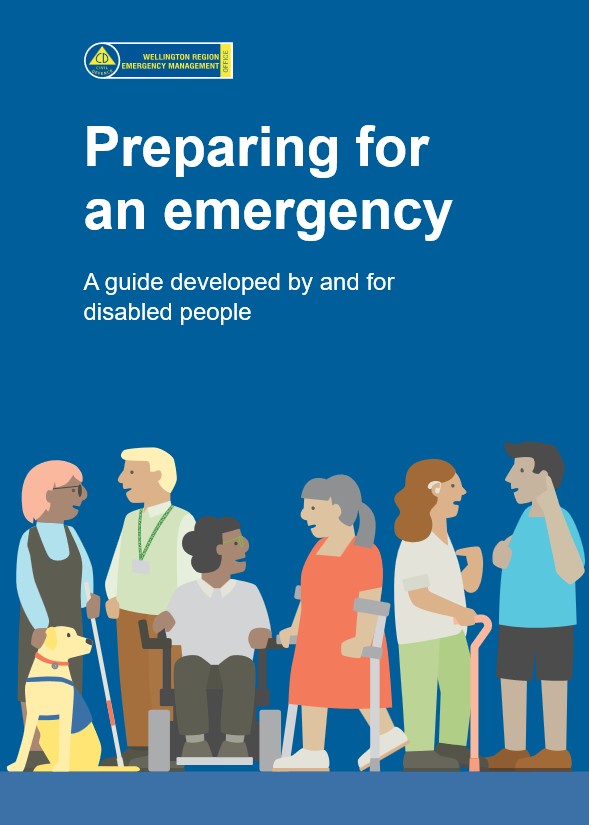
We’re proud to share WREMO’s new disability-inclusive emergency preparedness guide. It has been developed by and for disabled people in Aotearoa New Zealand to support practical, person-led planning before an emergency happens.
This guide is based on the Person-centred Emergency Preparedness (P-CEP) Workbook, developed by Prof. Michelle Villeneuve and Collaborating for Inclusion at the University of Sydney. You can read the original research, explore the workbook and learn how it was codesigned in Australia here: collaborating4inclusion
The Aotearoa New Zealand version and project was led by Renee Santos, who is an Emergency Management Advisor with WREMO and a member of the disability community. WREMO worked with a paid national working group of disabled people and allies with experience in emergency preparedness. We also piloted the guide with local groups of disabled people and used their feedback to shape the final version. Some text, images and layouts have been adapted to better fit the New Zealand context.
This guide is part of a wider project to ensure disabled people have the tools, support and information they need to plan for and get through emergencies.
How it helps
The guide is the first part of a three-stage project.
It includes:
- Simple tools to support clear preparedness conversations
- Strength-based steps for building individual emergency plans
- Space to record key preparedness information
- A quick-reference “access needs card” for use during an emergency
- Workshops (coming soon) to support people and communities to use the guide together
It is the first framework of its kind in Aotearoa, and an important step toward more inclusive and consistent emergency preparedness and response across the country.
How to use the guide
Disabled people are used to managing and adapting to inaccessible situations every day. These are strengths that you can bring to emergency preparedness. Knowing how you manage every day is the first step in planning how you will manage in an emergency.
This guide breaks emergency planning into four simple steps. You do not need to do everything in one day — take your time and work through each step at your own pace. Once you’re done, keep the guide in your grab bag or somewhere easy to reach in an emergency.
The Four Steps of Emergency Planning
Step One: Understanding Your Daily Life
Identify your strengths, routines and access needs in your everyday life.
Step Two: Knowing Your Preparedness Level
Understand your risks, check how prepared you are, and practise lifesaving actions.
Step Three: Starting Your Emergency Plan
Create a plan that reflects what you need before, during and after a disaster.
Step Four: Sharing Your Plan and Getting Support
Talk through your plan with the people you trust. Identify any gaps and work on them together.
Using the coloured pages or topic descriptions
Light-blue pages/daily life:
Focus on your capabilities and how you manage your needs in daily life, before an emergency.
Light-pink pages/after an emergency:
Think about how you can use those capabilities and adapt your support needs after an emergency.
Using the Capability Wheel
The Capability Wheel shows eight parts of life to consider when planning for an emergency:
- Living situation
- Social Connection
- Transportation
- Assistive Technology
- Taking care of health
- Communication
- Assistance animals/pets
Think about your strengths and how you manage your needs day-to-day. Start wherever feels right for you and move around the wheel.
Focus on the areas that matter most to you and skip anything that does not apply.
Taken from the Person -Centred Emergency Preparedness (P-CEP) Capability Wheel and modified with permission to match our graphics. Published with permission www.collaborating4inclusion.org
Acknowledgements
The content and concepts in this guide are taken from the Person-centred Emergency Preparedness (P-CEP) Workbook, one component of the P-CEP process tool and framework. Learn about the P-CEP Workbook here collaborating4inclusion
- Villeneuve, M., Abson, L., Yen, I., & Moss, M. (2020). Person-Centred Emergency Preparedness (P-CEP) Workbook. Centre for Disability Research and Policy, The University of Sydney, NSW 2006. 652-2241, Issue 2/No 1 (Online)
The P-CEP workbook, the Four Emergency Planning Steps, the Capability Wheel and Level of Preparedness Scale are part of the original Framework and Process Tool, created by Prof. Michelle Villeneuve, University of Sydney and lead researcher at Collaborating4Inclusion.
With permission of Collaborating4Inclusion, some text, the layout, and images were adapted for New Zealand by Wellington Region Emergency Management Office (WREMO). Adaptations were undertaken in collaboration with a national working group of disabled people and allies who have experience in emergency preparedness. The guide was piloted with local groups of disabled people. Their feedback created the final version.
Ngā mihi nui/ special thanks to the national working group:
Vanessa Creamer
Tia Ikin
Chris Ford
Barbara Haricharan
Roger Drower
Tara Shepherd
Joanne Dacombe
Michael Nolan
WREMO would also like to thank members of People First, Community Connections Kāpiti, Disabled Persons Assembly and the Laura Fergusson Trust, as well as the disabled people in NZ and Australia who contributed their lived experience of preparedness and emergencies through the quotes in this guide.